Transcription had become a commodity, so Trint needed AI that helps journalists with the work after the transcript, in a way they can check. I led the design of the AI Assistant, from a one-question proof of concept in April 2025 to AI highlights in the editor, live since July 2026.
Annie Ying DutrembleSole designer · 10 min read
Timeframe
April 2025 to now (ongoing)
Role
Sole designer
Platform
Trint web app and desktop (and mobile until October 2025)
Team
Head of product, engineering lead, engineers, data scientists
Outcome
23,000+ prompts from about 4,000 users in its first five months, 56% of AI highlight suggestions accepted after checking, and cited in newsroom renewals
app.trint.com
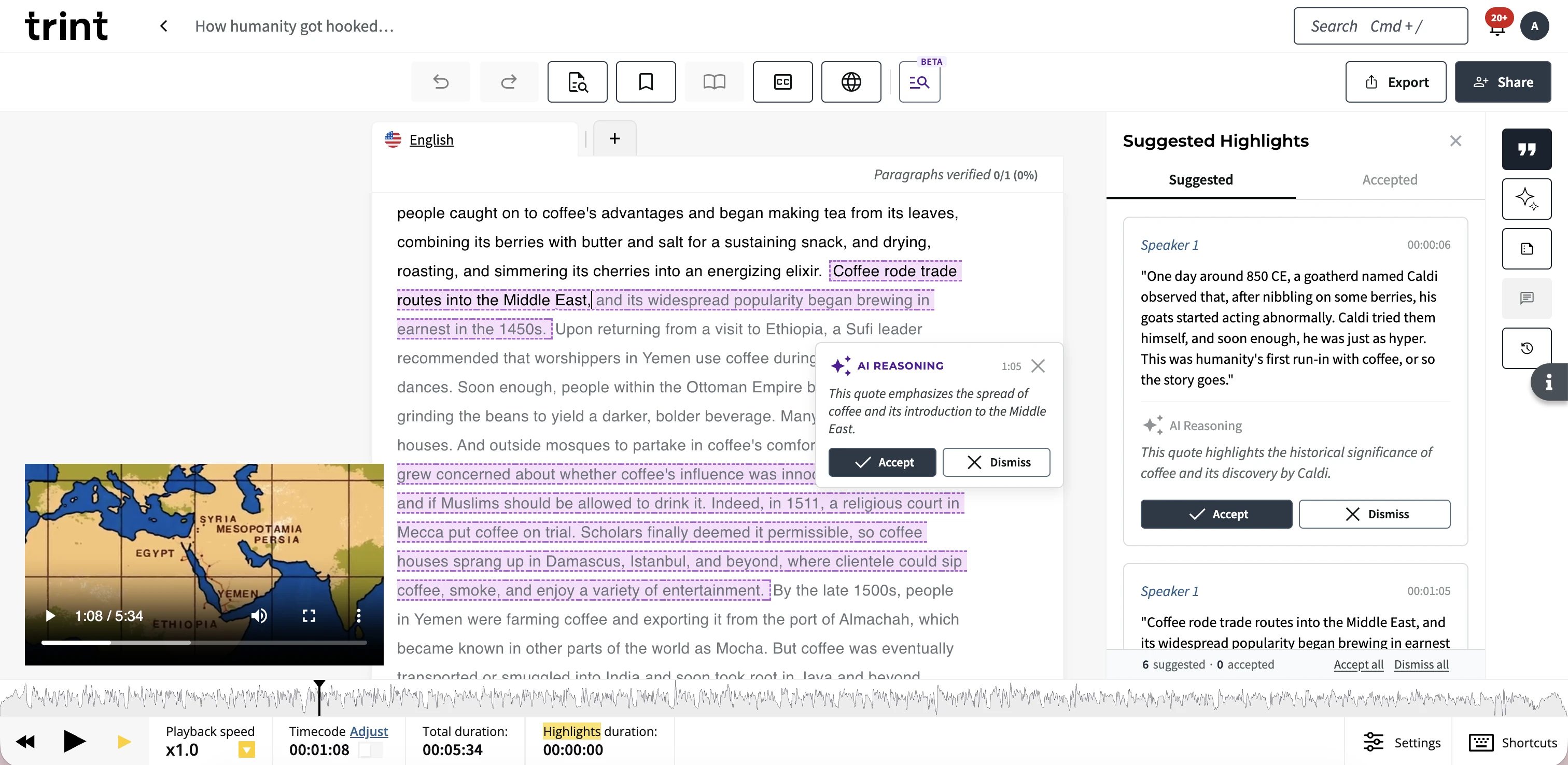
AI highlights as built: each suggestion shows its reasoning, and a journalist accepts or dismisses it
1. Discover
Why Trint needed an AI assistant
By early 2025, transcription was becoming a commodity, and our customers were doing the next step somewhere else.
People expected more than a transcript. Journalists wanted key points and quotes, and AI meant we could “finally offer real assistance” with the work after the transcript.
Competitors got there first. Rev, Descript and then Otter added AI chat, and we were losing deals over it.
Customers were doing it elsewhere. They pasted transcripts into Gemini and ChatGPT to get headlines and follow-up questions.
…for some use cases (eg Transcription of Google Meetings) we may not need to use Trint.A newsroom preparing a Trint vs Gemini comparison, April 2025
Enter the password to unlock all my case studies :)
Don’t have it? Request access and I’ll email it to you.